
In this lesson we went through a lot of the oldest forms of animation and devices used to show moving pictures. For example, the magic lantern that was made in the seventeenth century was basically the earliest form of a projector, and glass slides were used to project images or doodles. Pulling a strip that held all the slides, you could change images to show movement and/or story progression In this lesson we went through a lot of the oldest forms of animation and devices used to show moving pictures, for example, the magic lantern that was made in the seventeenth century. The magic lantern was basically the earliest form of a projector, and glass slides were used to project images or doodles. Pulling a strip that held all the slides, you could change images to show movement and/or story progression
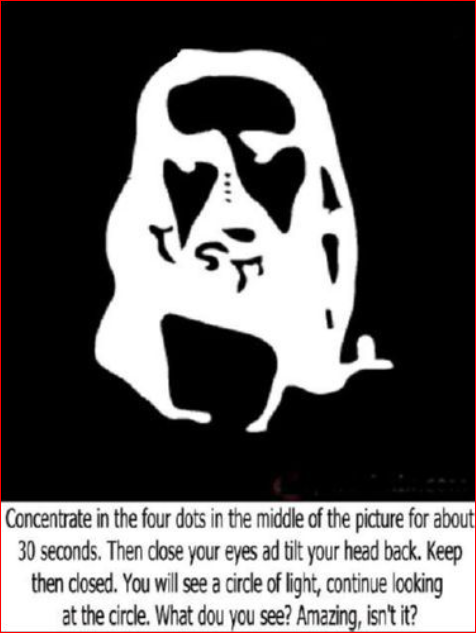
we also learned about the afterimage effect, which is a basic explanation to lots of optical illusions you see online. the afterimage effect is when an image continues to appear in your vision after the original image has been removed
in this lesson I realise that animation is heavily revolved around perception of humans, what the human eye can see and how we as animators can exploit that
We also learnt about different devices that can create the illusion of movement through spinning, such as the:
The Thaumatrope
The Zoetrope
The Praxinoscope
after searching up a zoetrope on my TikTok to see the modern-day creation process of one, I also came across a different type of device called the phenakistoscope.
the Phenakistoscope is a spinning disc that creates the illusion of movement and it’s most commonly viewed from the top down
Phenakistoscope
The Phenakistoscope is the first device to demonstrate continuous movement
It was independently invented by both Joseph Plateau and Simon von Stampfer in 1832.
A series of images are drawn onto a cardboard disc, and then slits are cut in the cardboard between each image. A spindle with a handle is then placed through the middle of the disc so that the disc can be easily turned by hand. The tip of the spindle is then placed on a mirror, with the sequence of images facing the mirror. The user then turns the spindle to rapidly spin the cardboard disc, and when the person looks through
one thing that made me particularly interested in this specific device was seeing the works of RICHARD BALZER

this lesson put into perspective how different earlty animation was to animation now in the modern day back then animatoors were more free to experiment there were no rules like smooth movement or perfect charecter designs it was juts making something , trying new things
The Enchanted Drawing (1900)
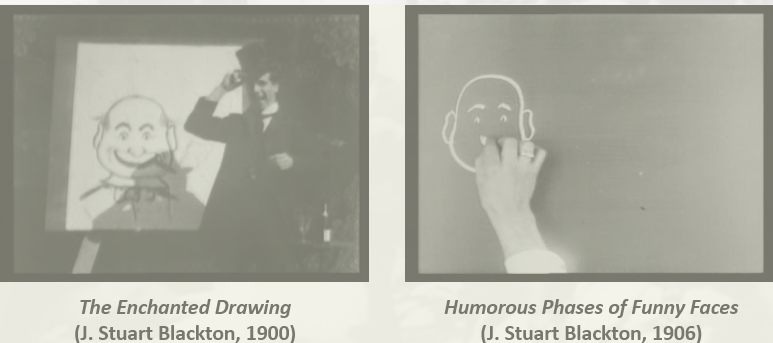
“The Enchanted Drawing” was shown in our lecture as part of a series of early animation films to demonstrate early methods of trick filming to conjure up magic effects. In this particular animation film, the animator himself makes an appearance in disguise as a magician to signify to the audience the strong linkage between animation and stage magic tricks.
One of the techniques employed in this movie is known as stop trick. In this technique, the movie is paused while something changes in the scene, and filming resumes. When it’s viewed, it looks as if something materialised instantly.
In the movie, the animator starts by sketching a bottle of wine from his sketchpad. The animator “pulls” the bottle from the sketchpad, and it instantly changes from a sketch to a real bottle of wine. In reality, this trick involved stopping filming. The animator would reach out to pick up what he had drawn, and then a real bottle would appear in his hands. The result would be smooth and seamless, like magic.
It shows how animation in its early form used tricks of what the eye sees. The animator had control over what he wanted to portray in the image and created illusions of magic where in truth it is formed from editing
The Presence of the animator
“Animation should be an art… what you fellows have done with it, making it into a trade…not an art, but a trade…bad luck.”
Winsor McCay
One thing that has stayed with me from this lecture – and, to be honest, has left me feeling rather emotional – is the retreating of animators over time. During the silent era, animators were very visible within their work. Blackton was in front of the camera, while McCay featured alongside Gertie, with very much a direct link between artist and animation. However, as animation grew more commercial and industrialised, animators became less visible and more interchangeable. This is more than just a visibility issue – they are no longer on screen – but also carries within it an emotion. Modern animation studios see animators as disposable labour, either working them to exhaustion or using corporate branding to suppress personal artistic expression. Especially with AI art and animation becoming popularised, it appears to this audience that animators are once again disappearing into the background. This directly refers to disappointment with McCay’s animation becoming “a trade, not an art form.”
Leave a Reply