In this two-week rotation, I will be learning the basics of how to create storyboards and animatics. I’ll be practicing quick, loose thumbnail sketches that show movement, conflict, and key moments of change. I’ll also be using Premiere Pro and sound to edit short animatics that feel dynamic and engaging. Through this rotation, I want to understand how storytelling, pacing, and visuals all work together to make a scene come alive.
Pre-production for me took forever. I had to make an animatic and I was in a rush because I was behind on other things like character design that was hard to figure out.
For my animatic I focused on the shapes of the characters the most and making them bouncy while showing lots of acting. I was very pleased with the outcome. They didn’t have any exact features, just bases for whatever character design I came up with.
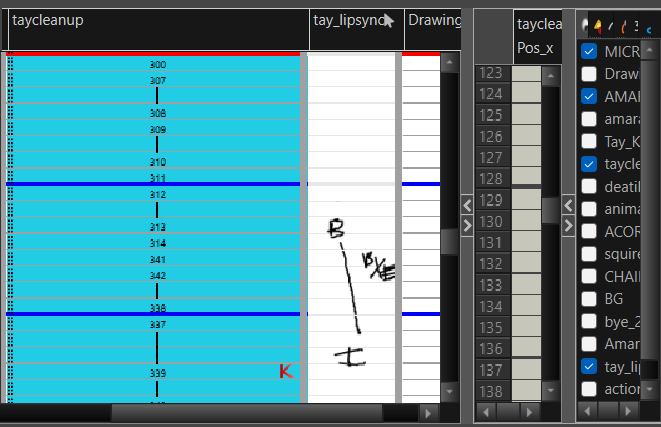
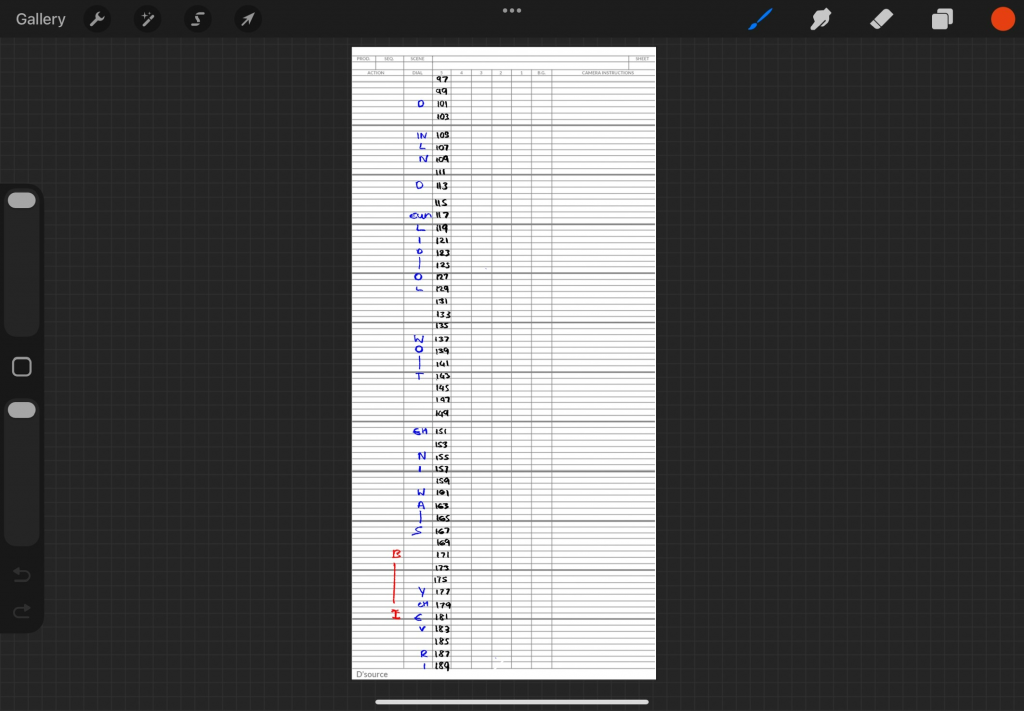
Once I finished the designs we were told to make X sheets. I felt like after learning about X sheets it would be a pretty easy task and kind of fun, like a puzzle. After watching videos on Toon Boom I found that I could make X sheets directly in Toon Boom that I could work from.
at the start of the scene the characters hair and cothles blow in the wind every two frames while his body and face stand still then he starts to inhale like he is about to speak his head elongates fro opening his mouth wider and his nose rises the rise of his nose forms his wrinkles near his mouth topper in his faces eyes widen and his eyebrows change from a neutral expression to more of an angry one by getting closer together his chest rises he then rises his head and opens his eyes wider and his eyebrow raise
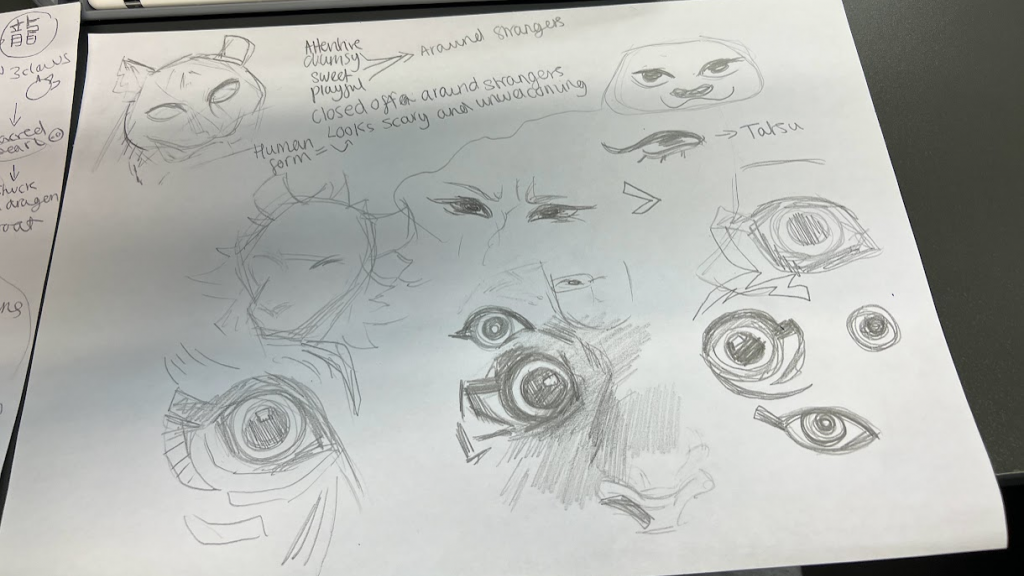
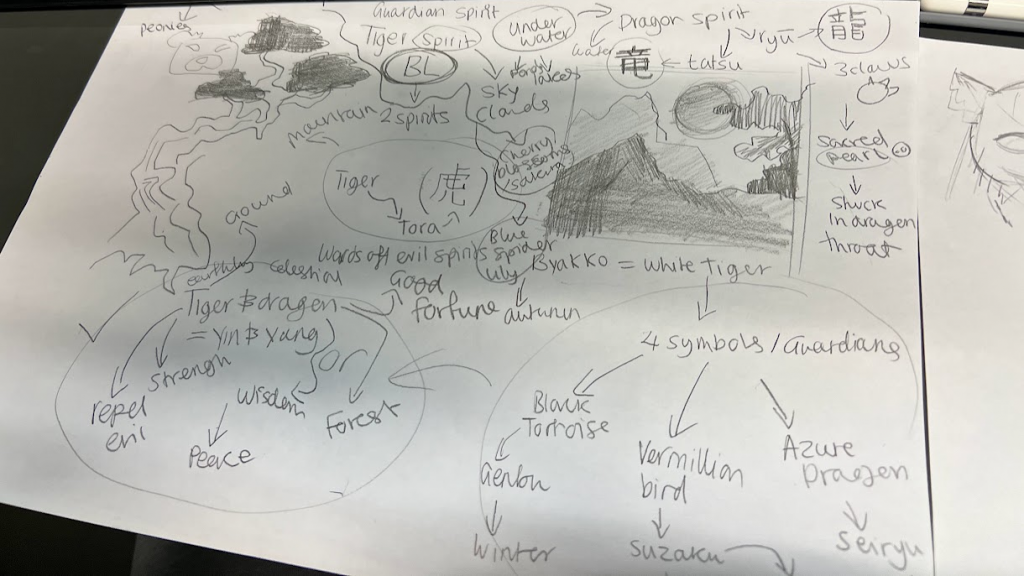
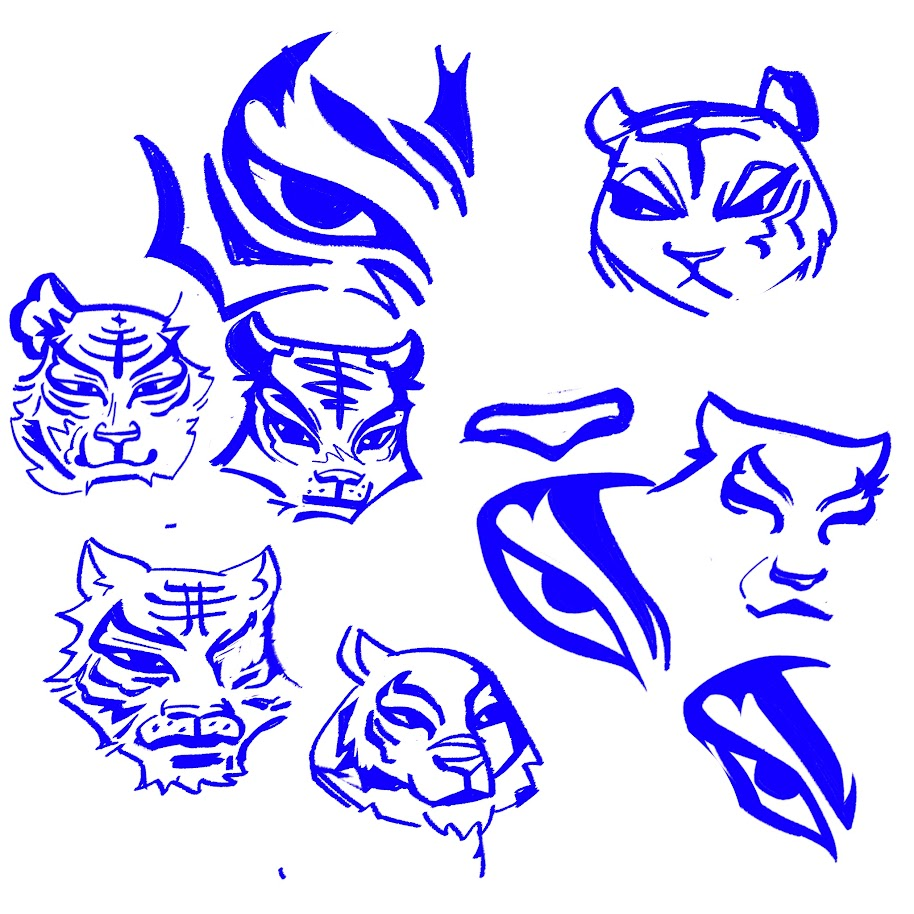
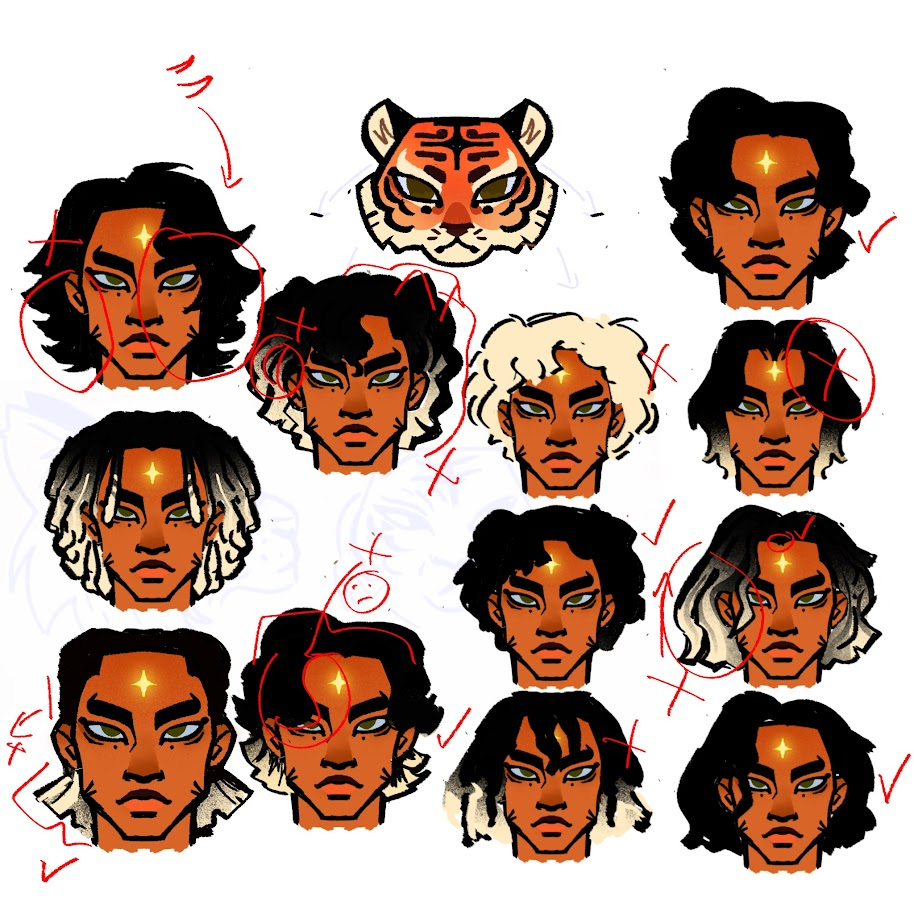
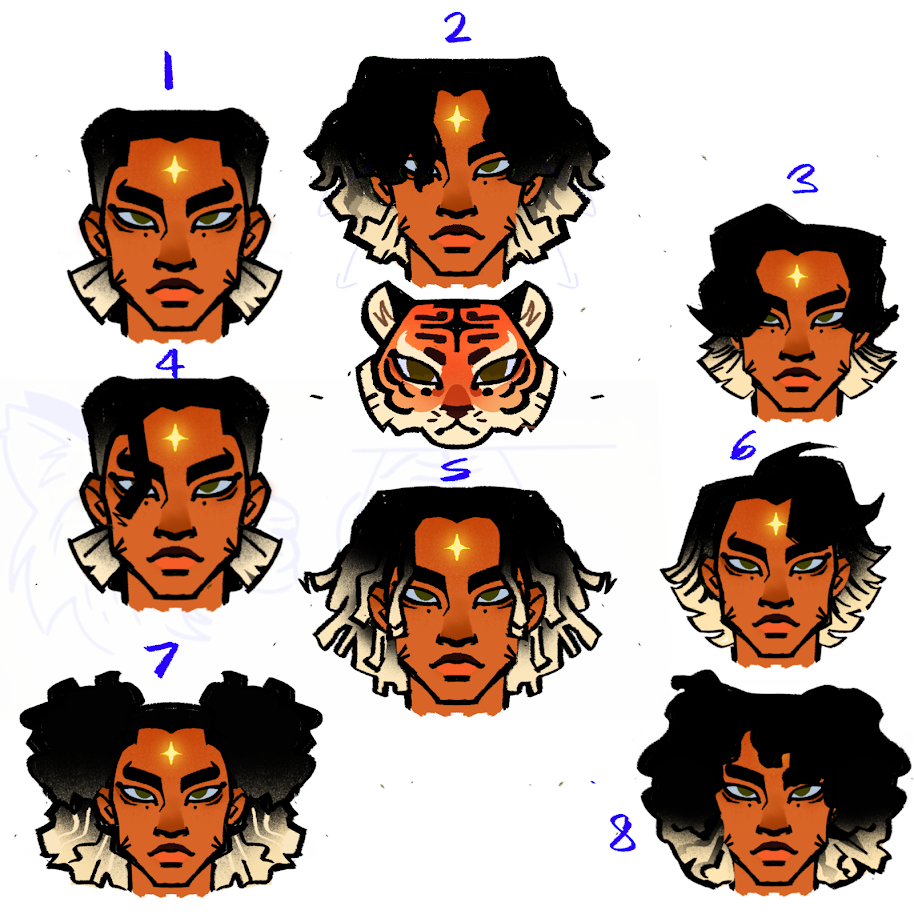
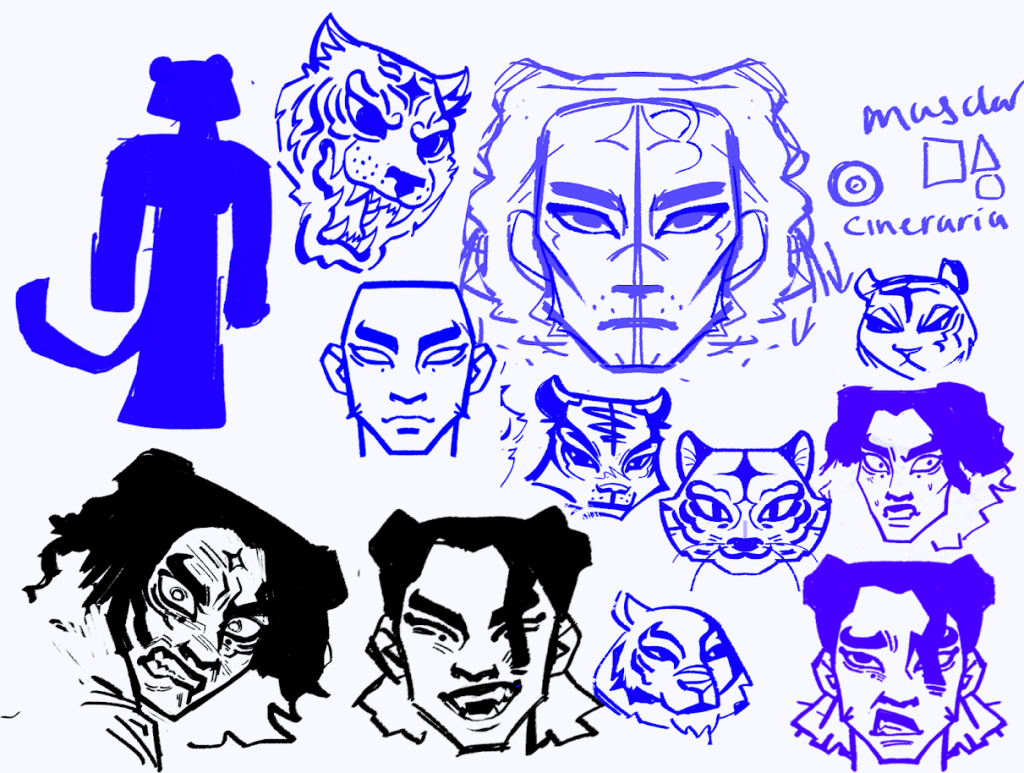
in this rotation we had to design an original charecter i decided that i wanted to challenge my self by designing an animal oc in the breaking character classes we were told to think of three words that describe our chareceters personality and from there start developing the charecter it took me while to land on my three words in the frist class i focused on figuring out the story and who my charecteres where i wanted the story to be about japanese guarian spirits a dragon and a tiger guardian spirit i tried to do some research ion dragon and tiger spirits to help me develop my ideas on their personality and environment
in the next class we were meant to make an abstract version of our character i made my charecter a tiger silhouette with paint in the classroom i felt like i could have made more and tried to push my tiger guardian spirits design to be more avbstract i also made sketchbook drawing with markers i did a soplit face of bioth guardian spirits dragon and tiger
In the second puppet project, we had to transform our puppet in some way. This time, I was a lot more vocal about my ideas and tried to better understand how the whole animation would take place. I took notes and even made storyboards, and we wrote a list of what we needed to create.
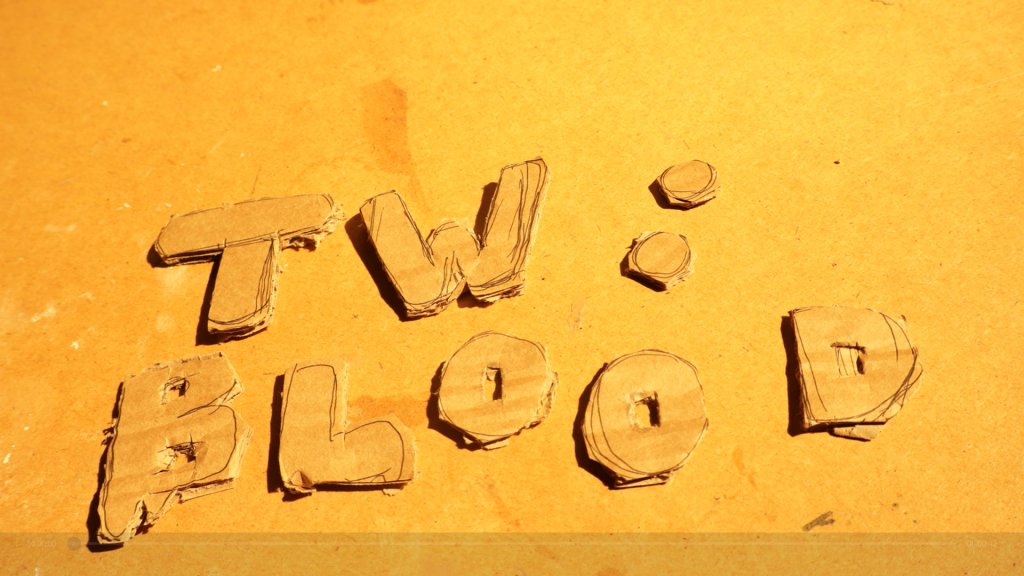
The idea was that she gets plastic surgery to fix her body. Instead of a box, I made a trapezium-shaped dress body and gave her a collar, placing her head into it. The body was not a closed shape. The back was open and had a handle going across it, which made it easier to hold and to attach the face. We also made blood construction elements, such as a hammer, and we had gingerbread men basically giving her surgery. I also made letters at the start of the animation to say ‘trigger warning: blood’.
When we were nearly finished, we had the idea to add a flash behind the eyes so they would be seen better. This was a really smart idea and made the transformation much clearer. However, when we exported the animation, we realised after leaving class that the ending was cut out. We checked the computer the next morning and got help from Mai to export it again with all the footage included.
While I do think this was a big step up from the last animation, I still think we could have done better. I had some trouble with the lighting at first, but I quickly corrected myself with Mai’s help. I also think the animation is too fast, and you do not really get time to process everything in some areas.
I made a Padlet where I put all my stop motion and other rotation animations since I wasn’t able to upload them here.
in the first workshop for introduction to animation we were taught all about how to analyse media specificvally in this case animation sand film , when analysing media we should not watch for entertainment but for research the analysois should be objective and not be a subjective opinion watching an animation u may not like u shouldnt just be like i hate this or this is boring instead make an informed arguement using evidence and explaining the filmakers choiceswether its visual sfx aorr pacing and explain what effect this has on you as the veiwer. we were practically told to analyse the film before u bash it
JOURNEY 1970 by Daniel szczechura
Initial emotional reaction:
My initial emotional response to this animation was that it seemed really dull and kind of annoying because, at first glance and in the first few seconds, nothing really happened, and you could just hear a bunch of repetitive screeching noise throughout the majority of the animation. When I first watched it, it was easy for me to get distracted by anything else because the repetitive starts make you think nothing really happened and it’s just a never-ending GIF. Despite feeling that way about the animation, I was really captivated by the monochrome and textured art style. I use textured and noise-filled retro-looking art as a major source of inspiration for my own work; the style initially seemed like a waste.
Analysis
When I watched it a few more times, I noticed a lot more things. In particular, at the beginning of the animation, you can hear the annoying screechy noise that sounds a lot like velcro, and then there is a jingle noise after I realised how it would slightly change at certain points in the animation. For instance, when the character opened the window for the first time, the jingke sound slightly changed, and when they were almost approaching a new city with a modern-styled background that greatly contrasted the fields that had been shown at the beginning of the animation, the sounds sort of started to echo and sound more factory-like. When the train finally appears in the city’s stylised surroundings, or should I say at the train station, the sounds start to sound more digital than they did before.
this does make me think that the animation might have something to do with time in ways than one one thing that does support the idea of past and future is how rthe background changes not jist form feilds to a white more detailed building but that u can see in the backgrounds as the ytrian moves a long differnt archeteture throughjout time liek i saw a barn house and i also saw yellow huts . if this aniamtion is supposed to signify the contrast between of past i think the animator uses other design elements to show the contrast in his feelings about the past and the future or potentiallly beven between rural countrysides and busy cities.
one thing i noticed a lot was the differnce it the background compistion between both parts of the animation the start being the country side and middle being the busy trainstation although the framing of the train is prominnent in both instances behind teh silhouette of the charecter thw indow space shows a lot it especially shows in the beging the country side the emptyness the more open and free spaces it is underwelhing and pretty much open but when it gtes to the trainstation the building takes up a lot of the background composyition as well as silhouiettes of people and it seems way more overwhelming than the countryside the fact that teh silhouetees of peopel even distrupt the framing of the train conceling the charecter before they disappear shows the overcrowded feeling of the trainstation
another thing i relaised with the noise is that it corresponds with the metal bars shown passing while train moves a long and in the end when the red bar passes the sound changes again and also starts to get a lot more louder
Our third project for animation was to make a puppet that we had to animate from only cardboard and also like tape to stick things together we got in to groups of three
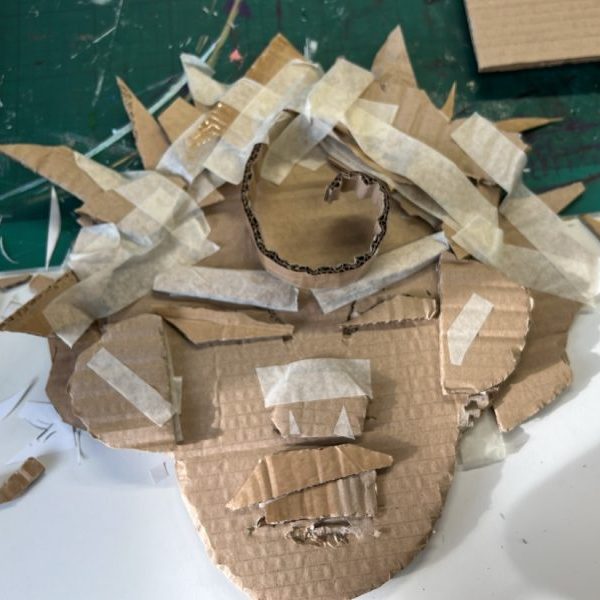
In our puppet making we reused my old head from the previous project to make a face
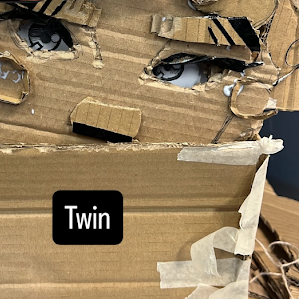
One of my partners were kinda explaining how they was imagining the puppet a lot of the ideas I didn’t really get so I tried to double check and ask again I mainly focused on the face and one of my partners made eyes by cutting holes in the head and putting paper be kind but like in a box shape making the paper farther away
I took some time making her hair by adding spirals and other parts of her face and used black tape to make eyelashes and I also gave her fingers I was not pleased with how my puppet came out at all especially after looking at different groups. The puppet came out way too big; its torso was just a box and its arms and legs were strings. i feel like i should have spoke up more in the group and it would have been better if we made her smaller and maybe didn’t stick everything down and together so we had more opportunities to animate her smoother and easier. Also, I think, like other groups we should have tried to make joints or pieces that can lock into each other or rotate
Another thing that I felt was really unclear was her storyline. We should have thought about it a lot more in order to come up with a better idea of how she looks, but honestly I felt like we rushed too much.
When it came to recording, I was in charge of lighting and taking pictures of each frame.
For this, we used Dragonframe, which I did not really understand at first since I had not used it before. When we set our puppet down and I was adjusting the lighting, I realised that you could not see her eyes at all and that they were casting a shadow because the lens was behind the cardboard. This was really disappointing because I personally felt like her face was one of her best features, and no one could see her eyes, which are a huge part of her head.
I had to adjust the lighting so that the puppet was more visible while also making sure that my other partners, who were in charge of posing the puppet, could not be seen behind it.
In the first hour, we made a lot of mistakes, which prompted me to tell them that we should start over. I felt like everything was moving really fast and was not properly thought through. At some point, I did give up and just followed the group by taking frames when they told me to. I think this project made me hold back how I felt a lot, which was not good.
I am not used to working in groups, and this experience made me feel even more against it. However, I knew that I would have to do more group work in the future, so I made it a priority to change my approach when dealing with group projects going forward.
Our second project in class was to make a cardboard face. We were told to just come up with anything and not be too serious about it, so I tried to do that I did think of making my own persona as my cardboard face, but it didn’t exactly turn out like that I wasn’t really pleased with my outcome. I used a lot of masking tape, which I wish I realised not to use since later on that became a problem.
We were told to look around class at other faces and take pictures to record them morphing into each other on the stop-motion app and then we were told our next task, which was morphing your face that you made into the person next to you’s face. I found this really difficult since the faces of my partners and mine were really different, and also we were not allowed to use more than 5 to 6 frames for the transition, so any frames I did use I had to cut out; therefore, the animation was in no way smooth.
I made a Padlet where I put all my stop motion and other rotation animations since I wasn’t able to upload them here.
This was my first animation in class on my first day. We were given the task of creating transformation animations using pieces of paper cut into different shapes. I immediately knew that I wanted to use a star shape since it’s my favourite shape, and I include it in most of my work. For this task, we were introduced to the Stop Motion app from the App Store. I thought it was really cool because it showed that you don’t need fancy programmes to make a good animation.
For this animation, I wanted it to look like a twinkling star, so I decided to transform a square into a star. I started by cutting out different shapes in different sizes and styles, and I coloured each piece of paper with a yellow highlighter. Then I began animating. One problem I had at first was filming. I was sitting right by the window, and when I started recording, I realised the light from outside was affecting the images. I also kept accidentally moving the camera. To fix this, I found a box on a table behind me, placed my phone on the box with the lens hanging slightly over the edge, and started animating again. The box blocked the light from the window and stopped me from moving the camera accidentally.
I really loved this animation, and it became my first stop-motion and paper animation. This project taught me how simple materials and creative problem-solving can still make an animation look smooth and expressive.